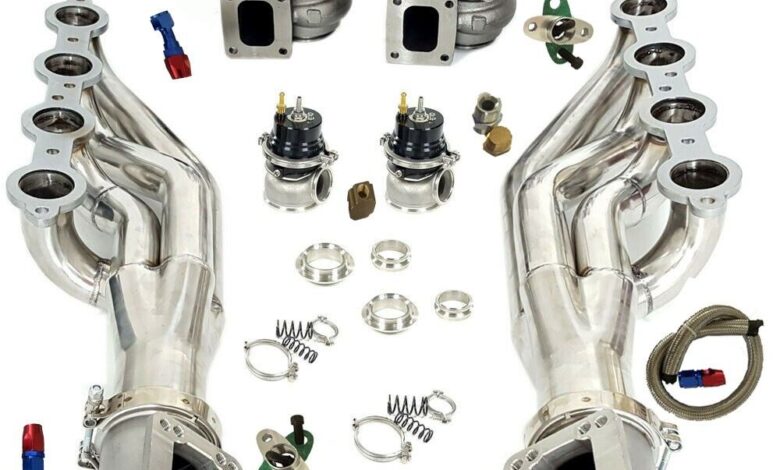
The street racing scene has evolved. Gone are the days when a simple camshaft and gear swap guaranteed victory at the local “Mexico” meet. Today, if you are rolling in a 1995 SN95, a 2003 New Edge, or a 2005-2007 S197, you are bringing a knife to a gunfight unless you have forced induction. While superchargers are common, the true underdog weapon is boost generated by exhaust gas. For owners of these mid-model GTs, finding the right Turbo kits for 1995, 2003, 2005, 2006, 2007 Mustang GT is the difference between watching taillights and collecting cash.
The SN95 (1995): The 5.0 Awakening
The 1995 Mustang GT holds a special place in history. This has been the final year of the pushrod 5.0L Windsor V8 prior to the modular machine switch. For street racers, this is a blessing. The 302 Windsor is notoriously durable under boost.
However, “kit” is a loose term for the 1995 model. Most off-the-shelf Turbo kits for 1995 Mustang GT revolve around the On3 Performance chassis kit. Because the SN95 shares its suspension geometry with the Fox Body, turbo piping routes similarly. A typical 1995 setup uses a single 76mm or twin 62mm turbos mounted low in the engine bay. The challenge? The stock hypereutectic pistons. If you are racing on the street, you cannot exceed 8-10 psi without a forged bottom end. A well-tuned 1995 GT with a 76mm turbo will put 450-500 horsepower to the wheels—enough to humble a stock Coyote.
The New Edge (2003): The 2V Screamer
The 2003 Mustang GT (New Edge) features the 4.6L 2V SOHC engine. Critics say these heads don’t flow. Street racers say they don’t care because boost fixes everything.
When searching for Turbo kits for 2003 Mustang GT, the market is dominated by modular-specific kits. On3 Performance offers their “67mm Turbo Kit” specifically for the 1999-2004 chassis. For roughly $3,000, you get the manifold, intercooler, and piping. The 2003 chassis has more room than the SN95, allowing for easier installation of front-mounted intercoolers.
A 2003 GT with a stock bottom end is limited to about 450 horsepower. But turn the boost up on a built motor, and the 4.6L becomes a monster. In street racing no-prep events, a 2003 GT with a Precision 76mm turbo is a common “dark horse” entry—it looks stock but makes 700 hp.
The S197 (2005-2007): The 3V Revolution
The 2005 to 2007 Mustang GT represents the S197 chassis with the 4.6L 3V engine. This is the most refined of the three, featuring variable cam timing (VCT). It is also the most expensive to turbocharge due to the tight engine bay and electronic complexity.
Turbo kits for 2005, 2006, and 2007 Mustang GT usually require a tuner who understands VCT logic. Hellion Power Systems offers a “Sleeper Kit” that tucks twin turbos under the chassis. On3 also produces a single turbo kit for the 2005-2010 models.
The 3V engine has weaker connecting rods than the 2V. On the street, you cannot safely exceed 450-500 horsepower on the stock bottom end without risking a “windowed” block. However, a 2007 GT with a simple 62mm single turbo and a proper 93-octane tune will run 11-second quarter miles easily, even in full interior street trim.
Street Racing Considerations
Before you buy a kit, understand the street racing reality. Turbo kits require supporting mods. You will need:
- Fuel System: 39lb injectors won’t cut it. You need 60lb or 80lb injectors and a 255lph or 340lph fuel pump.
- Clutch: The stock clutch will evaporate on the first hard launch.
- Tuning: A mail-order tune is dangerous. You need a dyno tune or a reputable handheld tuner (SCT or HP Tuners).
The Verdict
Is it cheaper to sell your 2006 GT and buy a Coyote? Yes. Is it cooler to pop the hood of a 1995 SN95 and reveal a polished turbo kit? Absolutely.
The beauty of these chassis is weight. A 2003 GT weighs 500 lbs less than a modern Mustang. Add 150 horsepower with a turbo kit, and you have a genuine street killer. Whether you are building a 1995 nostalgia car or a 2007 track monster, the right turbo setup levels the playing field. Just remember to save the racing for the strip—but the building happens in your garage.