
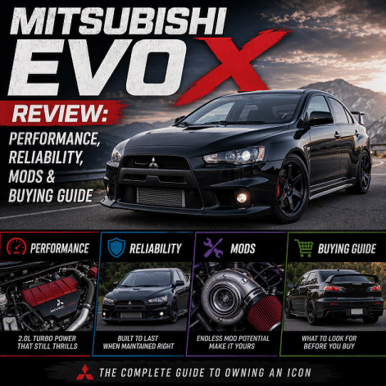
The Mitsubishi Lancer Evolution X, commonly called the Evo X or Evo 10, was the final generation of Mitsubishi’s legendary Lancer Evolution performance sedan. Introduced in 2007, it brought a new turbocharged engine, sophisticated all-wheel-drive technology, a more rigid chassis, and the option of a six-speed dual-clutch transmission.
For enthusiasts looking for a four-door performance car with serious handling ability, the Evo X remains an interesting choice on the used market. However, it is also a more complicated car than earlier Evos, and age, maintenance history, modifications, and transmission choice can make a major difference.
So, is the Evo 10 still worth considering? This review looks at its performance, handling, interior, reliability, modifications, strengths, weaknesses, and what buyers should know.
Evo 10 Engine and Performance
One of the biggest changes for the Evo X was its engine. Mitsubishi replaced the previous-generation 4G63T with the 4B11T, a 2.0-liter turbocharged and intercooled inline-four with an aluminum cylinder block and MIVEC variable valve timing.
The 4B11T gave the Evo X a different character from earlier generations. It was designed as a modern performance engine while retaining the turbocharged four-cylinder formula that had defined the Evolution.
Power output varies depending on market, model year, and version, so buyers should check the specifications of the particular car rather than assuming every Evo X has the same factory output.
The engine responds well to sensible modifications, which is one reason the Evo X remains popular with enthusiasts. Intake and exhaust changes, intercooling improvements, engine management, and other supporting modifications can be used to build a faster car, although increasing power also places greater demands on the drivetrain and cooling system.
Evo 10 Transmission: Manual vs TC-SST
One of the biggest decisions when considering an Evo X is the transmission.
The five-speed manual is the traditional enthusiast choice. It provides direct driver involvement and was used in the GSR and later Final Edition models. Mitsubishi’s 2015 Final Edition was based on the five-speed manual version and received increased engine output compared with earlier standard models.
The other option was Mitsubishi’s six-speed Twin Clutch Sport Shift Transmission, known as TC-SST. Rather than a conventional torque-converter automatic, it uses two clutches and automated gear changes. Mitsubishi developed it to provide fast shifting while retaining much of the response associated with a manual transmission.
TC-SST can be extremely effective when working properly, but it also makes the car more mechanically complex. On an older used Evo X, transmission condition and maintenance history deserve particular attention.
For a buyer who prioritizes maximum driver involvement and a simpler enthusiast setup, the manual is attractive. Someone who prefers rapid automated shifts and easier daily driving may prefer TC-SST.
Super All-Wheel Control and Handling
Handling is arguably the Evo X’s biggest strength.
The car introduced Mitsubishi’s Super All-Wheel Control system, or S-AWC. It integrates systems including the active center differential, Active Yaw Control, Active Stability Control, and ABS to manage traction, torque distribution, and braking.
This technology is a major reason the Evo X can feel so composed when driven quickly.
Rather than simply using all-wheel drive to improve traction, the Evo X uses its drivetrain and electronic systems to influence the car’s behavior through corners. The result is strong grip, predictable responses, and impressive confidence when accelerating out of bends.
The Evo X is particularly enjoyable on roads with plenty of corners. Its ability to put power down while maintaining stability is a major part of the car’s appeal.
What Makes the Evo 10 Fun to Drive?
The Evo X combines several characteristics that work particularly well together:
- Turbocharged four-cylinder power
- All-wheel drive
- Sophisticated torque and stability management
- Strong brakes
- Responsive steering
- A rigid performance-oriented chassis
- Aggressive suspension tuning
It is not simply a fast sedan in a straight line. The real attraction is how the engine, drivetrain, brakes, and chassis work together.
The downside is that the same performance-focused setup can make the Evo X less comfortable than an ordinary family sedan.
Evo 10 Interior
The interior is one of the areas where the Evo X shows its age.
The cabin is functional rather than luxurious. Materials and dashboard design are not likely to impress someone coming from a modern premium sports sedan.
However, the interior makes more sense when the car is considered for what it was designed to do. Supportive seats, a driver-focused layout, and straightforward controls fit the performance character of the car.
Technology also varies considerably depending on model year and trim, so buyers should inspect the equipment of the specific car rather than judging every Evo X by one specification.
Evo 10 Exterior and Design
The styling of the Evo X is more modern and aggressive than previous Lancer Evolution generations.
The large front opening, wide stance, muscular bodywork, rear wing, and performance-oriented proportions immediately separate it from a standard Lancer.
Whether the design is attractive is subjective. Some enthusiasts prefer the sharper, more compact appearance of the Evo VIII or Evo IX, while others consider the Evo X the more mature-looking car.
One thing is certain: the Evo X does not look like an ordinary economy sedan once equipped with the appropriate performance trim and wheels.
Evo 10 Modifications and Tuning
The Evo X has a large enthusiast following, so modification options are extensive.
Common areas for modification include:
Intake and Exhaust
Intake and exhaust upgrades can improve airflow and change the sound of the 4B11T. However, modifications should be matched with appropriate engine management and supporting hardware rather than simply adding parts individually.
Intercooling
Because the engine is turbocharged, controlling intake temperatures is important for consistent performance. An upgraded intercooler can become particularly useful on modified cars.
Suspension
BC Racing BR Coilovers reviews, springs, dampers, sway bars, bushings, and alignment changes can transform the handling characteristics.
For a street car, however, extremely aggressive suspension settings can make the car uncomfortable and may reduce its usefulness as a daily driver.
Brakes
The Evo X already has serious braking hardware, but brake pads, fluid, rotors, and tires can be upgraded depending on whether the vehicle is primarily used on the street or track.
Wheels and Tires
Good tires are among the most important performance upgrades. The sophisticated all-wheel-drive system cannot compensate for poor or worn tires.
Evo 10 Reliability and Common Concerns
Buying an Evo X requires more attention than buying an ordinary used sedan.
The biggest concern is usually not the model itself but the condition of the individual car.
A modified Evo may have been driven aggressively, repeatedly tuned, launched hard, or maintained poorly. That makes service records particularly valuable.
Potential buyers should pay attention to:
- Engine condition
- Turbocharger condition
- Oil leaks
- Cooling system condition
- Clutch condition on manual cars
- TC-SST operation and maintenance on dual-clutch models
- Differential and drivetrain servicing
- Suspension wear
- Brake condition
- Accident or structural damage
- Quality of previous modifications
- Evidence of repeated track or drag use
A completely stock, well-maintained Evo X can be a very different ownership proposition from a heavily modified example with questionable history.
The Good Things About the Evo 10
There are plenty of reasons enthusiasts still want one.
1. Excellent all-weather traction
The S-AWC system gives the Evo X remarkable traction and stability. Mitsubishi specifically developed the system to integrate four-wheel drive, yaw control, stability control, and braking functions.
2. Strong turbocharged performance
The 4B11T provides a solid foundation for both stock driving and carefully planned performance builds.
3. Exceptional cornering ability
The Evo X is at its best when the road starts twisting. Its drivetrain and chassis make it much more than a straight-line performance sedan.
4. Practical sedan layout
Unlike a two-seat sports car, the Evo X provides four doors and useful everyday practicality.
5. Huge tuning potential
There is a large enthusiast community and an extensive aftermarket for Evo X black market performance reviews modifications.
6. Historical significance
The Evo X is the tenth and final generation of the Lancer Evolution line. Mitsubishi ultimately ended the Evolution series after this generation, making the Evo X an important part of the model’s history.
The Bad Things About the Evo 10
The car is not perfect.
1. Heavy compared with earlier Evos
The Evo X grew significantly compared with earlier generations. That extra size and weight can make it feel less raw than an Evo IX.
2. Harsh ride
Performance-oriented suspension and tires can make the Evo X uncomfortable on rough roads.
3. Basic interior
The cabin does not provide the luxury or refinement expected from many modern performance sedans.
4. Expensive ownership
Performance cars require performance-car maintenance. Tires, brakes, drivetrain components, and quality modifications can become expensive.
5. Modified examples can be risky
A cheap modified Evo X is not necessarily a bargain. Poor tuning or neglected maintenance can create expensive problems for the next owner.
6. TC-SST adds complexity
The dual-clutch transmission is technologically impressive, but buyers of used cars should be especially careful about its condition and maintenance history.
Evo 8 vs Evo 10
The Evo 8 is generally more old-school in character. It has the smaller, lighter-feeling personality many enthusiasts associate with classic Lancer Evolution models.
The Evo X feels more mature and technologically sophisticated. Its S-AWC system, newer 4B11T engine, and available TC-SST give it a different character.
If you want rawer old-school Evo character, an earlier generation may be more appealing. If you want newer technology and a more modern interpretation of the formula, the Evo X makes more sense.
Evo 9 vs Evo 10
The Evo IX is one of the most highly regarded generations among enthusiasts, and comparisons with the Evo X are inevitable.
The Evo IX uses the famous 4G63T engine, while the Evo X introduced the 4B11T. The X also brought a newer chassis and significantly more sophisticated electronic drivetrain technology.
Neither is automatically the better choice.
The Evo IX may appeal more to someone seeking the classic Evolution experience, while the Evo X offers newer engineering and a more modern platform.
Is the Evo 10 Still Worth Buying?
The answer depends heavily on what you expect from it.
If you want a comfortable modern sedan with inexpensive maintenance, the Evo X probably isn’t the right choice.
If you want a practical four-door car with serious performance, excellent all-wheel-drive traction, strong cornering ability, and a large tuning community, the Evo X remains compelling.
The most important thing is to buy the condition of the car rather than simply buying the badge.
A documented, carefully maintained example is far more attractive than a heavily modified car with an unknown history.
Last Statement
The Mitsubishi Evo X represents the end of one of the most recognizable performance-sedan stories in automotive history.
It is not as light or as simple as some earlier Lancer Evolution models, and its interior and ride quality can leave something to be desired. The ownership costs can also be significant, particularly when buying an older or heavily modified example.
But its strengths are difficult to ignore.
The turbocharged 4B11T, sophisticated S-AWC system, strong chassis, all-wheel-drive traction, and extensive tuning potential make the Evo X a genuine performance car rather than simply a sporty version of an ordinary sedan.
For enthusiasts searching for an Evo 10 review, the most important conclusion is this: the Evo X is not perfect, but it remains a special car because it combines everyday sedan practicality with serious performance and one of Mitsubishi’s most advanced four-wheel-drive systems. Jackspania racing reviews
And because it was the final Lancer Evolution, its place in Mitsubishi performance history makes it even more significant today.