

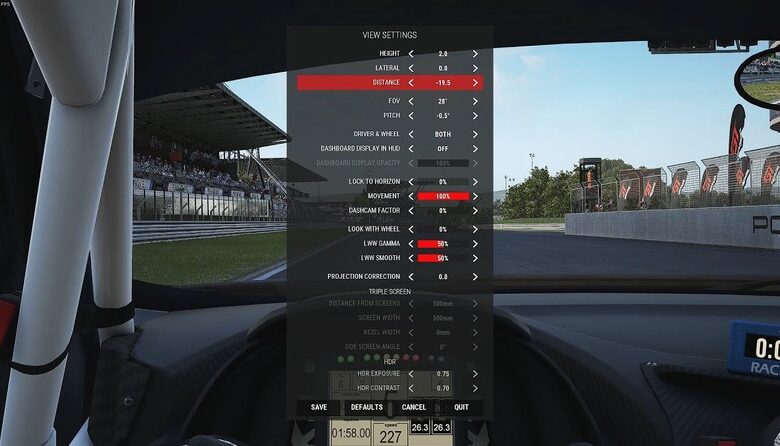
You just measured your screen, calculated your viewing distance, and plugged the numbers into an fov calculator sim racing tool. The result should be perfect. But when you hit the track, everything feels wrong. Corners arrive in slow motion. You feel disconnected from the car. You second-guess every braking point. There is an entirely different discussion that no sim racing blog has covered: the physiological perception gap between mathematically correct Field of View (FOV) and how your brain actually processes speed.
When you use a standard fov calculator sim racing, the tool applies a simple geometric formula based on screen size and viewing distance. But your brain does not process vision geometrically. It processes vision biologically. The disconnect between pure math and human perception is why so many sim racers abandon “correct” FOV settings and revert to wider, more comfortable views. This article exposes the hidden flaw in traditional FOV calculation and reveals a hybrid approach that delivers both accuracy and speed perception.
The Geometry-Only Lie: What Calculators Miss
Most fov calculator sim racing tools, including popular online calculators and even built-in game utilities, rely on a single trigonometric formula. You give them your screen width, viewing distance, and perhaps screen angle for triple monitors. They return a number. The math is sound. The problem is not the math. The problem is what the math ignores.
Your human visual system has two distinct modes of processing: central vision (the fovea) handles detail, color, and sharpness. Peripheral vision handles motion, contrast, and crucially, speed perception. The geometric FOV calculation treats your entire screen as if your eye processes every pixel equally. It does not.
When you sit in a real race car, your peripheral vision constantly feeds speed information to your brain. The blur of trackside objects, the rush of asphalt, the sense of velocity – these come primarily from the edges of your visual field, not the center. A standard fov calculator sim racing tool assumes that the virtual camera should display exactly what you would see through a window the size of your monitor. But your monitor has no peripheral vision. Your brain expects peripheral cues that are not there. The result? A mathematically “correct” FOV that feels like driving in slow motion.
The Pro-Sim FOV Utility developers have recognized this gap, noting that traditional calculators rely only on a “distance ÷ width formula” while their tool integrates “human physiology and spatial perception, ensuring realism that pure math cannot achieve”. They specifically reference that human binocular vision spans approximately 120 degrees – the critical zone where your brain fuses depth and perspective.
Why “Correct” FOV Feels Zoomed In
When you use an fov calculator sim racing on a typical single 24-27 inch monitor sitting 60cm from your eyes, the result is usually between 25 and 35 degrees of horizontal FOV. This is mathematically correct for a window of that size at that distance. But here is the problem: your natural human FOV is roughly 180-200 degrees horizontally. You are trying to experience a 180-degree world through a 30-degree window.
Your brain compensates by slowing down perceived motion. Objects entering a narrow window appear to move across it quickly, but the sense of velocity requires peripheral reference points. Without them, speed feels muted. This is why so many sim racers who use a standard fov calculator sim racing tool complain of feeling disconnected from the car. The math is right. The perception is wrong.
One experienced racer put it bluntly: “Using an FOV calculator to set up your racing sims doesn’t work. If you use the numbers that they generate, it feels like you could step out and go make a sandwich before the next turn comes up. What is needed is a sensation of speed calculator”.
The Peripheral Vision Correction Factor
So how do you solve the perception gap without introducing distortion? The answer lies in understanding peripheral vision correction – a concept that advanced FOV tools are beginning to address. The Pro-Sim utility documentation explains that “central vision (~60°) handles detail, but peripheral vision drives speed perception.” A proper FOV calculation “ensures that edge-of-screen cues are processed naturally, so drivers feel velocity without staring at the speedometer”.
For single-screen users, this means accepting a degree of compromise. Fanatec, a leading sim racing hardware manufacturer, acknowledges this reality: “On a smaller single monitor, you should try to get it as close as possible, but even then, the true FOV value can feel very limited with no peripheral sensation. In this scenario, increasing the FOV slightly above the ‘correct’ value can be a practical compromise. Although it may not be perfectly accurate, it can improve usability while still delivering a satisfying driving experience”.
The key word is “slightly.” Do not double your calculated FOV. Do not use default arcade-style wide angles. Instead, take the result from your fov calculator sim racing and add 5-10 degrees as a perception compensation. This preserves geometric accuracy for braking points and apex judgment while restoring a natural sense of speed.
The Binocular Vision Reference
Advanced FOV calculators are now incorporating what is called the 120° Binocular Vision Reference. Human vision spans 200-220 degrees, but the critical zone for depth perception is the binocular overlap region of roughly 120 degrees. Within this zone, both eyes work together to create stereoscopic depth perception. Outside this zone, monocular peripheral vision detects motion.
A standard fov calculator sim racing does not account for the difference between binocular and monocular vision. Your screen, no matter how large, occupies only a portion of your binocular zone. The rest of your binocular field expects visual information that is not there. Advanced tools align the virtual FOV with your natural binocular vision zone, creating what developers call a “1:1 ‘Royal Flush’ simulation”.
For triple-screen setups, this becomes even more critical. The side monitors should cover your peripheral vision while the center screen handles the binocular zone. The correct angle between screens is as important as the FOV itself.
The Triple-Screen Correction
If you race on triple monitors, an fov calculator sim racing tool becomes both more powerful and more complex. The geometry of three angled screens introduces additional variables: screen angle, bezel thickness, and curvature radius for curved monitors.
One documented issue with triple-screen setups is that standard calculators often miscalculate the effective width of curved monitors, treating them nearly the same as flat screens. This has been corrected in advanced utilities that now apply proper mathematical formulas for the “geometric chord” of curved panels.
For triple screens, your fov calculator sim racing should also account for monitor angle. Typically, side monitors are angled toward the driver at 45-60 degrees. This angle must be added to the FOV calculation, along with bezel compensation to prevent objects from appearing misaligned when crossing between screens.
The formula for triple-screen horizontal FOV is:
Total FOV = (2 × Single Screen FOV) + (2 × Angle Compensation) + Center Screen FOV
But even this formula suffers from the perception gap. Many sim racers find that adding 5 degrees of “peripheral bleed” improves speed sensation without breaking spatial accuracy.
Curved Monitor Correction
Curved monitors add another layer of complexity. An fov calculator sim racing that supports curved screens must calculate the reduction in horizontal visual width caused by the curvature. The radius rating (1800R, 1500R, 1000R) determines how much the screen wraps around your field of view. A lower R-number means more curvature.
The corrected formula for curved screens uses the chord length rather than the straight-line width. This is not a minor adjustment. Some users reported that before this correction, curved screen FOV values were “nearly identical to flat screens” – a significant error. If your fov calculator sim racing does not have a dedicated curved screen checkbox, it is likely giving you incorrect values.
The Hybrid Approach: Math + Perception
After researching this topic extensively, the optimal approach is a hybrid method that respects both geometry and human biology. Here is the step-by-step protocol:
Step 1: Get Your Geometric Baseline
Use any standard fov calculator sim racing tool to get your mathematically correct FOV. Input your screen size, aspect ratio, and viewing distance.
Step 2: Apply the Peripheral Compensation
Add 5-10 degrees to the horizontal FOV for single screens. For ultrawide or triple screens, add 3-5 degrees. This compensates for missing peripheral speed cues without breaking spatial accuracy.
Step 3: Test at a Familiar Track
Take a car you know well to a track you know well. Watkins Glen and Spa are excellent test tracks because they have distinct elevation changes and braking zones. Adjust your seating position in-game (not the FOV) to fine-tune the view.
Step 4: The “Pants Test”
As one real-life racer described: “Adjust your FOV until when you get to turn two and head up the hill through the esses, your brain screams, ‘Oh my God! You’re driving into a wall of asphalt!’ You should almost crap your pants. If the hill looks that steep, and your sense of speed feels fast, your FOV is correct, regardless of what the FOV calculators tell you”.
This subjective test is the final validation. Numbers get you close. Your brain makes the final call.
Game-Specific FOV Implementation
Different racing sims handle FOV differently. Some use vertical FOV (ACC, Assetto Corsa), others use horizontal FOV (iRacing, AMS2). Your fov calculator sim racing should output both values.
For Assetto Corsa Competizione: Use the vertical FOV value. Enter it into the graphics menu, then try 1-2 degrees more or less until braking distances feel natural.
For iRacing: iRacing has its own built-in calculator, but you can compare results. Enter the diagonal and distance as prompted.
For Richard Burns Rally: This sim uses a non-linear FOV calculation unlike most modern sims. Standard calculators produce distorted results. You need a tool specifically calibrated for RBR’s graphics engine.
Stop Blindly Trusting the Numbers
The fov calculator sim racing tools available today are excellent starting points. They provide geometric accuracy that default game settings cannot match. But they are not perfect. They cannot account for the biological reality of human perception – the gap between your central and peripheral vision, the way your brain processes speed, and the compromise required when experiencing a 180-degree world through a 30-degree window.
The best sim racers do not blindly trust the calculator. They use it as a baseline, apply a small perception compensation, and then fine-tune based on real track experience. If your “correct” FOV feels painfully slow, you are not wrong. Your brain is telling you something important. Listen to it. Add a few degrees. Test at a familiar track. Adjust until the sensation of speed matches your expectations. The next time you reach for an fov calculator sim racing, remember: the math gets you close. Your perception gets you the win.