
Talladega Superspeedway is best known for NASCAR competition, but its racing history also includes a series of IMSA sports-car events during the 1970s. The available race archives document IMSA events at Talladega in 1971, 1972, 1974, 1975, 1976 and 1978, with gaps in 1973 and 1977. These races brought Chevrolet Corvettes, Porsche 911s and Carreras, BMW 3.0 CSLs, Datsun Zs and other sports cars to the Alabama circuit.
The Talladega IMSA story also changed considerably during the decade. Early events were 200-mile GT races, while the 1975 race used a one-hour format and the 1978 event became a six-hour endurance race. The progression provides a useful look at how sports-car competition developed at an Alabama venue better known today for high-speed stock-car racing.
Talladega’s Road-Course Racing
The 1971 IMSA event was held on a permanent road course listed by Motorsport Magazine as four miles in length. That configuration provided a different racing environment from the oval racing for which Talladega became famous.
The IMSA fields also differed from NASCAR’s stock cars. GT competition brought production-based sports cars and touring-style machinery into the same event, with different classes allowing cars with different specifications to compete.
The historical results show a mixture of American and European manufacturers throughout the decade. Chevrolet Corvettes appeared prominently in the early races, while Porsche and BMW became important parts of the field later in the decade.
1971: IMSA Arrives at Talladega
The first documented IMSA Talladega race took place on May 15, 1971. Motorsport Magazine identifies the event as the Carter Hall GT Series and a round of the IMSA GT Championship. The IMSA season archive lists the Talladega race as a 200-mile event and the second round of the 1971 season.
Thirty cars started the race, which covered 50 laps of the 6.437-kilometer circuit. Dave Heinz won overall in a Chevrolet Corvette after completing the distance in 1:54:08. Peter Gregg and Hurley Haywood finished second in a Porsche 914/6, while Michael Keyser and Ash Tisdelle followed in Porsche 911S cars.
The result immediately demonstrated the mixture of American and European GT machinery that characterized the Talladega IMSA races. The Corvette took the overall victory, while Porsche occupied several of the leading positions.
1972: The Inver House ‘Bama 200
IMSA returned to Talladega on August 5, 1972, for the Inver House ‘Bama 200. The race was the seventh round of the 1972 Camel GT Challenge. Twenty-seven cars started the event, which covered 50 laps and 321.869 kilometers.
Wilbur Pickett won the race in a Chevrolet Corvette after completing the 50 laps in 1:47:24. Tony DeLorenzo finished second in another Corvette and recorded the fastest lap of the race at 2:04.327. Dan Daughtry finished third in a Corvette, while Gene Felton was fourth in a Chevrolet Camaro 427.
The results illustrate the importance of Chevrolet machinery in the GTO portion of the field during this period. The 1972 season itself also included several classes, including GTO, GTU, TO and TU, showing that IMSA competition was not limited to a single type of vehicle.
1973: A Gap in the Talladega IMSA Schedule
The available Talladega sports-car archive does not list an IMSA event for 1973. Its documented sequence moves from the 1972 event to the return of IMSA competition in 1974.
That gap is worth noting because Talladega’s IMSA history was not an uninterrupted annual series throughout the decade.
1974: The Talladega 200 Returns
IMSA returned on August 10, 1974, for another 200-mile Talladega race. Thirty-two cars started, with the field completing 50 laps of the circuit.
Milt Minter won overall in a Chevrolet Corvette entered by John Greenwood Racing. Michael Keyser finished second in a Porsche Carrera, followed by George Dyer and Peter Gregg in Porsche Carreras. Minter completed the 50 laps in 1:43:03.200.
The 1974 result therefore continued a pattern already visible in the earlier Talladega races: American Chevrolet GT cars competed against Porsche machinery for overall positions.
1975: The IMSA One-Hour Talladega Race
The format changed in 1975. Instead of another 200-mile race, IMSA scheduled a one-hour Talladega event on August 9.
Thirty-one cars started, and the race covered 29 laps, or 186.684 kilometers. Hans-Joachim Stuck won in a BMW 3.0 CSL after completing the race in 1:01:54.500. Peter Gregg finished second in a Porsche Carrera, with Hurley Haywood third in another Porsche Carrera.
Stuck also recorded the fastest lap, a 2:05.400. The result marked a change in the manufacturer at the front of the Talladega IMSA field, with BMW replacing Chevrolet as the overall winner.
The shorter race format also shows that Talladega’s IMSA schedule was not restricted to a fixed distance. The event format changed from the 200-mile races used in 1971, 1972 and 1974.
1976: The ‘Bama 200
The 1976 Talladega event was called the “‘Bama 200,” although the archived results record the actual race as 30 laps, or 193.121 kilometers, approximately 120 miles. Twenty-four cars started.
Peter Gregg won overall in a BMW 3.0 CSL after completing the 30 laps in 1:08:34.284. Phil Currin finished second in a Chevrolet Corvette, followed by Bob Christiansen in a Chevrolet Camaro. Al Holbert finished fourth in a Ford Cobra II, while Brad Frisselle was fifth in a Datsun Z.
Michael Keyser set the fastest lap in a Chevrolet Monza with a time of 1:56.600. Keyser’s car, however, retired after six laps, so the fastest-lap result and overall victory went to different competitors.
The 1976 field demonstrates the variety of machinery competing in the IMSA series. BMW, Chevrolet, Ford, Datsun and Porsche cars all appear among the classified finishers.
1977: Another Gap
The Talladega sports-car archive does not list an IMSA event at the circuit in 1977. The next documented IMSA race is the six-hour event held in 1978.
The two gaps in 1973 and 1977 are useful parts of the historical record because they show that Talladega’s relationship with IMSA changed over the course of the decade rather than following a continuous annual schedule.
1978: The Talladega 6 Hours
The 1978 event was substantially different from the earlier Talladega IMSA races.
Held on April 2, 1978, the Talladega 6 Hours formed part of the Camel GT Challenge, the FIA World Challenge for Endurance Drivers, IMSA GTO and IMSA GTU. It was also the third round of the 1978 IMSA championship.
The event attracted 59 entries. Forty-one cars qualified and 40 started, while 25 were classified as finishers. The race lasted six hours and covered 175 laps, equivalent to 1,126.541 kilometers according to the race archive.
Porsche 935 Takes the Overall Victory
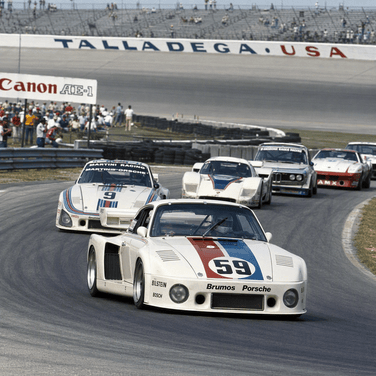
Peter Gregg and Brad Frisselle won the race in a Porsche 935 entered by Brumos Porsche. Their car completed 175 laps and finished first overall.
The same Porsche started from pole position. Peter Gregg’s qualifying time of 1:52.364 was recorded at 206.2455 km/h. Gregg also set the overall fastest race lap, completing a lap in 1:53.400.
The second-place car was another Porsche 935, driven by the Whittington brothers, while Dick Barbour and Johnny Rutherford finished third in a Porsche 935/77A.
Multiple IMSA Classes
The 1978 race also provides a clear example of multi-class endurance racing.
The documented classes included IMSA GTX, IMSA GTO, IMSA GTU and American Challenge, with IMSA Racing Stock also represented in the results.
The overall winner came from GTX, while the GTO class was won by Dave Cowart and Fernandez in a Porsche Carrera RSR. The GTU class winner was Lee Mueller and Thomas in a Porsche 911. The American Challenge class was won by Johnny Rutherford and Wallace in an Oldsmobile Cutlass.
This multi-class structure meant that the six-hour race contained different types of cars competing simultaneously, with class victories being recorded alongside the overall result.
The Cars of Talladega’s IMSA Era
The Talladega races of the 1970s featured a wide range of manufacturers.
Chevrolet
Chevrolet was represented by models including the Corvette, Camaro and later the Monza. Corvettes won the 1971, 1972 and 1974 Talladega IMSA events recorded in the historical results.
Porsche
Porsche became a major presence in the field. The cars included the 914/6, 911, Carrera and 935.
The 1978 six-hour race was particularly Porsche-heavy. Racing Sports Cars records 21 Porsche entries, compared with six Chevrolet and six AMC entries.
BMW
The BMW 3.0 CSL was another important car in the middle of the decade. Hans-Joachim Stuck won the 1975 one-hour event in a 3.0 CSL, while Peter Gregg used the same model to win the 1976 Talladega race.
Other Cars
The Talladega results also document Datsun Z cars, Ford Cobra IIs and Mustangs, AMC products, Oldsmobiles and other machinery.
This variety illustrates the broad range of cars permitted by the different IMSA categories during the period.
Drivers Associated With Talladega IMSA Racing
Several drivers appear repeatedly in the Talladega results.
Peter Gregg participated in multiple Talladega IMSA races and won the 1976 event before sharing the winning Porsche 935 with Brad Frisselle in 1978. Hurley Haywood also appeared repeatedly, including the inaugural 1971 event and the 1975 race.
Other notable Talladega winners included Dave Heinz in 1971, Wilbur Pickett in 1972, Milt Minter in 1974 and Hans-Joachim Stuck in 1975.
The results provide a chronological record of the drivers and cars that competed at Talladega rather than a single continuous championship story.
Talladega IMSA Timeline: 1971–1978
| Year | Event | Recorded format | Winner |
|---|---|---|---|
| 1971 | 200-mile Talladega | 50 laps | Dave Heinz, Chevrolet Corvette |
| 1972 | Inver House ‘Bama 200 | 50 laps | Wilbur Pickett, Chevrolet Corvette |
| 1973 | No listed IMSA Talladega event | — | — |
| 1974 | 200-mile Talladega | 50 laps | Milt Minter, Chevrolet Corvette |
| 1975 | 1 Hour Talladega | 29 laps | Hans-Joachim Stuck, BMW 3.0 CSL |
| 1976 | ‘Bama 200 | 30 laps / 120 miles | Peter Gregg, BMW 3.0 CSL |
| 1977 | No listed IMSA Talladega event | — | — |
| 1978 | Talladega 6 Hours | 175 laps / 6 hours | Peter Gregg / Brad Frisselle, Porsche 935 |
The race archive identifies Talladega sports-car events in 1971–72, 1974–76 and 1978–79, supporting the documented sequence shown above.
A Different Side of Talladega’s Racing History
The IMSA races add another layer to the history of Talladega as a motorsports venue.
During the 1970s, the circuit hosted GT and endurance competition involving cars from Chevrolet, Porsche, BMW, Ford, Datsun, AMC and other manufacturers. The formats also changed from 200-mile races to a one-hour event and eventually a six-hour endurance race.
The 1978 six-hour race stands out because of its size and multi-class format. Forty cars started, 25 finished, and the overall victory went to the Brumos Porsche 935 of Peter Gregg and Brad Frisselle.
Taken together, the surviving race records show that Talladega’s 1970s history included a substantial sports-car component alongside the track’s better-known stock-car events.
Sources for Further Research
The historical race information for this article was compiled from motorsport archives and race-result databases, including Motorsport Magazine’s 1971 Talladega IMSA database, the Racing Sports Cars Talladega archive, and archived IMSA results for the individual seasons.
The 1978 race is documented particularly extensively, including its entry list, qualifying results, class structure, finishing order and fastest laps.