The Nissan 240SX S13 has become one of the most recognizable Japanese performance cars of the late 1980s and early 1990s. With rear-wheel drive, a relatively simple mechanical layout, independent suspension, and a large aftermarket following, the S13 240SX has remained popular with enthusiasts interested in street builds, drifting, restoration, and motorsport.
Sold in the United States from the 1989 model year through 1994, the 240SX was offered as a coupe and hatchback, with the convertible appearing later in the model’s run. While it was not originally marketed as an extreme sports car, its rear-wheel-drive chassis and straightforward construction gave it considerable potential for modification.
Understanding the original Nissan 240SX S13 specifications is useful whether you’re looking at a stock example, restoring one, or planning a performance build.
Nissan 240SX S13 Overview
The S13 is the first generation of the Nissan 240SX sold in North America. It belongs to the broader Nissan S-chassis family, which also includes cars such as the Silvia and other market-specific variants.
The North American 240SX was designed as a sporty but practical coupe or hatchback. Its combination of rear-wheel drive, four-wheel independent suspension, and relatively manageable weight eventually made it particularly attractive to enthusiasts.
Today, finding a completely stock S13 can be difficult. Many surviving examples have been modified, drifted, restored, or used as project cars.
Nissan 240SX S13 Specifications
Exact specifications vary according to model year, body style, transmission, and market. However, the following characteristics define the typical North American S13 240SX:
- Front-engine layout
- Rear-wheel drive
- Four-cylinder gasoline engine
- Five-speed manual or automatic transmission
- Four-wheel independent suspension
- Two-door coupe or hatchback body styles
- Four-wheel disc brakes on many configurations
- Seating for four
- Relatively lightweight construction compared with many modern vehicles
The S13’s relatively simple layout is one reason it remains attractive to enthusiasts. There is enough room to modify the chassis without dealing with the complexity found in many newer performance cars.
Nissan 240SX S13 Engine
One of the most important parts of the 240SX S13 engine story is the KA-series four-cylinder.
North American 240SX models were primarily equipped with the KA24E and later KA24DE engines.
KA24E
Earlier S13 240SX models used the KA24E, a 2.4-liter four-cylinder engine with a single overhead camshaft.
The engine was designed with a focus on usable torque and everyday drivability rather than extremely high engine speeds. Compared with some of the smaller turbocharged engines found in Japanese-market performance cars, the KA24E has a different character.
Its relatively large displacement provides useful low- and mid-range torque, making it suitable for normal road use and providing a reasonable foundation for modified builds.
KA24DE
Later versions received the KA24DE, a 2.4-liter DOHC four-cylinder engine.
The KA24DE brought a different cylinder-head configuration and became particularly well known among 240SX enthusiasts. It is one of the engines most commonly associated with the North American S13 and remains a popular starting point for naturally aspirated and forced-induction projects.
The condition of an individual engine is important, however. Age, maintenance history, previous modifications, and abuse can have a much greater effect on reliability than the engine’s name alone.
240SX Horsepower
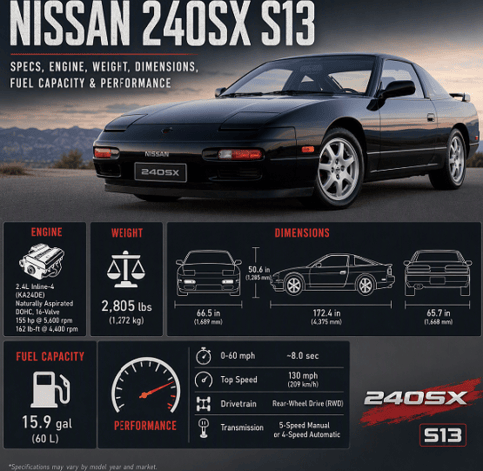
Factory 240SX hp figures vary according to model year and engine configuration, but the S13 was never designed to deliver the kind of factory horsepower associated with modern performance cars.
That does not mean the car is slow or uninteresting.
The S13’s relatively low weight and rear-wheel-drive layout allow modest power to remain enjoyable. Steering response, chassis balance, gearing, and driver involvement are major parts of the car’s appeal.
Modified examples can produce considerably more power, but horsepower should always be considered alongside tires, suspension, brakes, drivetrain condition, and cooling.
A 240SX producing substantially more power than stock requires more than simply adding a turbocharger. Fuel delivery, engine management, cooling, clutch, transmission, differential, brakes, and chassis components may all require attention.
240SX S13 Weight
240SX S13 weight depends on the body style, transmission, equipment, and model year.
One reason the S13 became so popular for performance applications is its relatively manageable mass compared with many newer vehicles.
Keeping weight under control can improve acceleration, braking, cornering, and overall responsiveness.
However, removing parts simply to achieve the lowest possible number is not always the best approach for a street car. Sound insulation, interior equipment, air conditioning, safety equipment, and other components contribute to everyday usability.
For a street-oriented build, reducing unnecessary weight while retaining useful comfort and safety equipment can provide a better compromise.
Nissan S13 Dimensions
The Nissan S13 dimensions make the 240SX relatively compact by modern standards.
Its exterior size contributes to the car’s easy maneuverability and makes it well suited to narrow roads, technical circuits, and controlled drifting environments.
Exact dimensions vary slightly according to body style and specification, so anyone restoring or modifying an S13 should verify measurements against the specific vehicle.
Wheel offset, tire width, suspension height, and body modifications are especially important when determining available clearance.
S13 Fuel Tank Capacity and Fuel Tank Size
Questions about S13 fuel tank capacity and S13 fuel tank size are common among owners.
The fuel tank was designed around the car’s original four-cylinder configuration and intended road use. Actual fuel range depends on fuel capacity, engine condition, driving style, gearing, tire choice, and modifications.
A modified 240SX may consume substantially more fuel than a stock example, particularly when equipped with forced induction or used for drifting.
For long-distance driving, fuel range should therefore be calculated from the actual vehicle’s consumption rather than relying only on the original specification.
Nissan 240SX S13 Transmission and Drivetrain
Rear-wheel drive is one of the defining characteristics of the 240SX.
Manual-transmission cars are especially desirable among enthusiasts because they provide greater driver involvement and make the chassis particularly suitable for performance driving.
The transmission and differential become increasingly important as engine output increases.
A stock drivetrain may work well with a healthy stock engine, but significant power increases can place additional loads on the clutch, gearbox, differential, axles, and other components.
Before increasing power, inspect the entire drivetrain rather than focusing only on the engine.
Suspension and Handling
The S13’s suspension is one of the reasons the platform remains popular.
Its independent suspension allows enthusiasts to tune the car for different purposes, including comfortable street driving, autocross, circuit racing, and drifting.
Common suspension changes include:
- Springs and dampers
- Coilovers
- Sway bars
- Adjustable suspension components
- Bushings
- Alignment changes
- Performance tires
- Chassis bracing
A lower ride height does not automatically make an S13 handle better.
Suspension geometry, damping, spring rates, alignment, tire characteristics, and available suspension travel all need to work together.
For a street car, excessive lowering can actually make the vehicle less predictable on uneven roads.
Nissan 240SX S13 Brakes
Braking performance becomes increasingly important as engine power and vehicle speed increase.
A healthy stock braking system can be adequate for normal street use when maintained properly. However, performance-oriented builds may benefit from upgraded pads, rotors, brake fluid, lines, cooling, or larger brake systems.
The correct brake setup depends on how the car is used.
A vehicle intended for occasional street driving has different requirements from one repeatedly used on a circuit.
Nissan 240SX S13 Performance Potential
The appeal of the S13 comes partly from its ability to respond to modifications.
A basic performance build can begin with:
- Quality tires
- Wheels with appropriate fitment
- Suspension improvements
- Brake upgrades
- Maintenance and cooling-system repairs
- Intake and exhaust improvements
- Engine tuning
More ambitious builds can include turbocharging, engine swaps, upgraded fuel systems, standalone engine management, stronger drivetrain components, and extensive chassis modifications.
The important principle is to build the vehicle as a complete system.
Adding substantial horsepower without improving traction, brakes, cooling, and drivetrain reliability can create an unbalanced car.
Nissan 240SX S13 Engine Swaps
Engine swaps are common in the S13 enthusiast community.
Some owners retain the original KA-series engine and modify it, while others replace it with another Nissan engine or a powerplant from a different manufacturer.
An engine swap can provide significant performance potential, but it also introduces considerable complexity.
Important considerations include:
- Engine mounts
- Wiring
- ECU and engine management
- Fuel system
- Cooling
- Exhaust fabrication
- Transmission compatibility
- Driveshaft
- Differential
- Brakes
- Vehicle weight distribution
A successful swap is therefore much more than installing a different engine.
S13 as a Drift Car
The S13’s rear-wheel-drive layout, compact dimensions, and large aftermarket have made it a popular drift platform.
For a drift build, engine power is only one component.
A successful setup may require attention to steering angle, suspension geometry, differential choice, cooling, braking, seat and restraint equipment, and chassis condition.
Tire selection is also extremely important.
Anyone practicing drifting should use an appropriate closed course or sanctioned facility rather than public roads.
Stock vs. Modified 240SX
A stock 240SX S13 offers a very different experience from a heavily modified car.
A stock or lightly modified vehicle can provide:
- Predictable road manners
- Original chassis balance
- Lower mechanical complexity
- Easier maintenance
- Greater originality
A modified car can offer:
- More power
- Sharper handling
- Improved braking
- Greater customization
- Track or drift capability
Neither approach is automatically better.
For collectors and restoration enthusiasts, originality may be the priority. For motorsport enthusiasts, performance modifications may be more important.
Common Nissan 240SX S13 Problems
Age is now one of the biggest concerns when buying an S13.
Even a car with a reputation for mechanical simplicity can develop problems after several decades.
Potential areas to inspect include:
- Cooling-system components
- Oil leaks
- Vacuum lines
- Engine seals
- Suspension bushings
- Ball joints
- Steering components
- Wheel bearings
- Brake components
- Fuel-system components
- Electrical wiring
- Rust and corrosion
- Previous accident repairs
- Poor-quality modifications
The condition of the individual vehicle matters more than the badge on the trunk.
A carefully maintained stock S13 can be a better project than a heavily modified example with questionable wiring and incomplete repairs.
Frequently Asked Questions
What engine does the Nissan 240SX S13 have?
North American S13 240SX models were primarily equipped with the KA24E and KA24DE 2.4-liter four-cylinder engines, depending on model year and configuration.
How much horsepower does a 240SX have?
Factory horsepower varies by model year and engine configuration. The S13 was designed more around balanced performance and drivability than outright horsepower.
How much does an S13 weigh?
S13 weight varies by body style, transmission, equipment, and model year. Modified vehicles can also differ significantly from factory specifications.
What is the S13 fuel tank size?
Fuel capacity depends on the specific model and market. Owners should verify the specification for their particular vehicle rather than assuming every S13 has identical equipment.
Is the Nissan 240SX S13 good for drifting?
The rear-wheel-drive layout, compact dimensions, suspension design, and large aftermarket make the S13 a popular drift platform. However, drifting should be performed only in controlled environments.
Is the KA24DE a good engine?
The KA24DE is a popular engine among S13 enthusiasts because of its displacement, availability, and modification potential. As with any decades-old engine, condition and maintenance history are critical.
Ending Statement
The Nissan 240SX S13 remains one of the most interesting Japanese performance platforms because of its combination of rear-wheel drive, compact dimensions, simple mechanical architecture, and enormous enthusiast support.
Understanding the original specifications is important before modifying one. Engine output, weight, dimensions, fuel capacity, suspension, brakes, and drivetrain characteristics all influence how the car behaves.
For an owner planning a project, the best approach is to start with the condition of the chassis and drivetrain, address maintenance issues, and establish a clear goal before buying performance parts.
A lightly modified street car, restored original example, drift project, and track build can all make sense on the S13 platform.
That flexibility is ultimately what has kept the Nissan 240SX S13 relevant decades after it first appeared on American roads.