
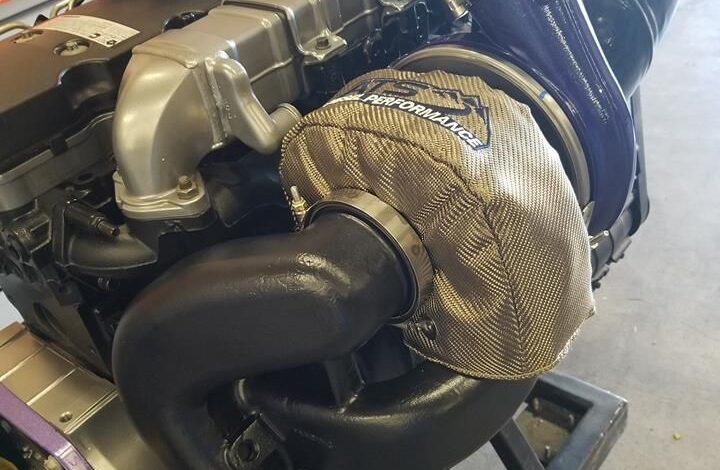
ATS Turbo 6.7 Cummins Review centers on one core fact: the 6.7L Cummins is a heavy-duty inline-six turbodiesel engine that powers Ram heavy-duty pickups, and ATS Diesel offers the Aurora VFR series as a drop-in replacement turbo upgrade. The number “6.7” refers to the engine’s displacement in liters, not a power rating or model year. The turbocharger itself is mounted on the exhaust side of the engine, bolted to the exhaust manifold, and its job is to force more air into the engine so it can burn more fuel and produce more power.
What Is the 6.7 Cummins?
The 6.7 Cummins is a 6.7-liter inline-six turbo-diesel engine produced by Cummins and used primarily in Ram heavy-duty trucks. In its current Ram pickup form, it produces up to 430 horsepower and 1,075 lb-ft of torque, while chassis cab versions are rated at 360 horsepower and 800 lb-ft. It is turbocharged and charge-air cooled from the factory, using a Holset variable-geometry turbocharger designed for towing and heavy loads. The engine is known for its cast-iron block and head, forged steel crankshaft, and a compression ratio around 19:1 in chassis cab applications.
What Is an ATS Turbo?
ATS Diesel Performance is an aftermarket company that builds upgraded turbochargers for diesel pickups. Their Aurora VFR series is designed as a direct drop-in replacement for the factory turbo on 6.7 Cummins-equipped Ram trucks. The ATS Aurora 4000 VFR Stage 2, for example, fits 2019-and-current Ram 2500/3500 trucks and is CARB-compliant for 50-state legal road use. It uses a billet compressor wheel with an 8×8 splitter design, high-silicon molybdenum castings, and dual turbine piston seals. ATS rates it to support up to 650 horsepower as a single turbo and 950 horsepower in a compound configuration. For earlier trucks (2007.5–2018), ATS also offers Aurora 4000 variants rated for up to 550 rear-wheel horsepower, with a 64mm billet compressor wheel.
What Does the Number 6.7 Mean?
The “6.7” in 6.7 Cummins refers to the engine’s total displacement: 6.7 liters. This is a measure of the combined volume swept by all six cylinders during one complete cycle. It is not a reference to horsepower, torque, model year, or any performance figure. The same displacement appears across multiple Cummins engine platforms, including the B6.7 used in industrial and commercial applications, though those are not identical to the Ram pickup engine. The number simply tells you the engine’s size class within Cummins’ lineup.
Where Is the Turbo Located?
On the 6.7 Cummins, the turbocharger is mounted on the exhaust side of the engine, typically in the valley between the cylinder banks on the inline-six layout. Service documentation for Ram 6.7 diesel trucks describes removing the turbocharger from the top of the engine compartment after disconnecting the intake air tube, coolant lines, oil drain tube, and the V-clamp at the exhaust outlet. The turbo bolts to the exhaust manifold, and the exhaust gas exits the engine through the manifold and into the turbine housing.
Which Vehicles Use It?
The 6.7 Cummins is used in Ram heavy-duty trucks. Current applications include the Ram 2500 and 3500 pickups, as well as the Ram 3500, 4500, and 5500 chassis cab models. The ATS Aurora VFR turbos are specifically listed for Ram 2500/3500 trucks with the 6.7 Cummins, with fitment split by year ranges: 2007.5–2012, 2013–2018, and 2019-and-current. The engine is not used in Ford, GM, or import trucks—those use different diesel platforms.
What Does It Do, and What Does It Deliver?
The turbocharger’s function is to use exhaust gas energy to spin a turbine, which drives a compressor that forces more air into the engine. More air allows more fuel to be burned, which increases power and torque. The factory Holset turbo on the 6.7 Cummins is a variable-geometry unit designed for responsiveness and efficiency under load.
An ATS turbo upgrade changes the delivery characteristics. According to ATS and retailer specifications, the Aurora 4000 VFR Stage 2 offers quicker spool times and increased efficiency compared to the factory turbo, along with a stronger exhaust brake (approximately 10 percent stronger) and improved engine braking performance. Customer reviews on the ATS product page describe the Stage 2 as “more responsive than stock” and note that the exhaust brake feels stronger, though one reviewer observed that it “spools a little slower than stock” while still rating it five stars. Another review called it a “great replacement” and “plug-in play as advertised”.
In terms of what it delivers, the ATS Aurora 4000 VFR Stage 2 for 2019+ trucks is rated to support up to 650 horsepower as a single unit and 950 horsepower in a compound setup. For 2007.5–2018 trucks, the Aurora 4000 is rated for up to 550 rear-wheel horsepower and is described as offering “up to 180+ HP over factory”. These figures represent the turbo’s airflow capacity, not a guaranteed power gain—actual results depend on tuning, fuel system, and supporting modifications. ATS states that the 2019+ Stage 2 turbo is a direct replacement for the Mopar part numbers 68444771AA and 68444771AB and requires no programming for installation.
In practical terms, the ATS turbo delivers a broader powerband, lower exhaust gas temperatures, and improved towing capability according to vendor descriptions and customer feedback. It retains the factory exhaust brake function and is designed to work with the factory emissions system on the applications where it is CARB-approved.
A Note on What “Review” Means Here
There is limited independent, long-term testing data available in the search results. The most direct customer feedback comes from ATS’s own product review page, which is moderated by the vendor and therefore not neutral. One third-party retailer comparison notes that ATS publishes dyno numbers for the 4000 VFR (47 rear-wheel horsepower on a stock tune, 150 rear-wheel horsepower tuned for 2013–2018 trucks), which gives a more concrete expectation than the “supports up to” figures. Anyone considering this upgrade should verify fitment for their specific model year and confirm whether tuning is required for their configuration, as requirements vary between the 2007.5–2018 and 2019+ platforms.