

Automotive AI, AI for automotive and Automotive CRM are becoming a practical part of modern dealership operations. For salespeople, BDC teams, service advisors, managers, and dealership owners, the important question is no longer whether AI exists, but how it can actually help the business.
Automotive AI brings artificial intelligence into the specific environment of automotive retail, where speed, customer communication, lead follow-up, inventory information, and appointment management all affect dealership performance.
This guide explains what AI means in a dealership, how agentic AI differs from traditional automation, and where dealerships can use AI without replacing the people who make customer relationships work.
What AI Means in a Dealership Environment
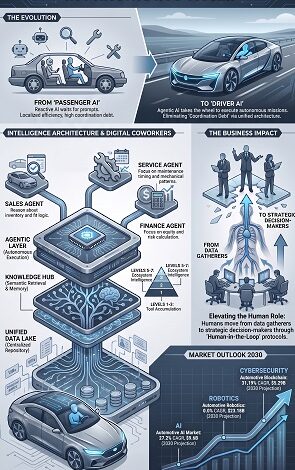
In a dealership, AI is best understood as a working business tool rather than a futuristic concept. It can help manage customer conversations, recognize what shoppers are asking for, answer routine questions, follow up with leads, and help move customers toward the next step.
Consider a customer who submits a vehicle inquiry at 10 p.m. A traditional process may leave that lead waiting until the next morning. An AI-powered system can respond immediately, understand the customer’s interest, provide appropriate information, and work toward scheduling an appointment.
That speed matters because automotive shoppers can contact multiple dealerships at the same time. The dealership that responds quickly has an opportunity to start the relationship before another store does.
The Difference Between AI, Automation, and Agentic AI
Automation typically follows predefined rules. A specific event triggers a specific action, such as sending a reminder after a certain period.
AI can understand information and generate responses based on the context of a conversation.
Agentic AI takes the concept further. An AI agent can interpret a customer’s intent, determine an appropriate next action, carry out that action, and continue working toward a defined objective.
For a dealership, that objective might be engaging a new lead, answering questions about a vehicle, recovering an inactive conversation, or helping schedule an appointment.
The difference is important because dealerships do not simply need more automated messages. They need technology capable of participating in useful customer conversations while operating within dealership rules and recognizing when a human employee should become involved.
Common Dealership Processes AI Can Support
AI for automotive can support many dealership workflows, particularly those involving high volumes of repetitive communication.
Sales Applications
Sales departments handle inquiries from dealership websites, third-party marketplaces, phone calls, social media, and other sources. Responding to every customer quickly can become difficult when sales teams are busy with customers on the lot.
AI can help engage new leads, answer common questions, follow up with shoppers, and work toward appointments. It can also continue conversations with customers who initially stop responding.
This does not mean removing salespeople from the process. Instead, AI can handle parts of the communication workload so sales professionals can spend more time with customers who require personal attention.
Service Applications
Service departments face their own communication challenges. Customers may need to schedule appointments, ask questions, confirm details, or receive reminders.
AI can assist with routine conversations, appointment requests, reminders, and frequently asked questions. By handling some repetitive communication, AI can give service advisors more time to focus on customers who are physically at the dealership or require more detailed assistance.
Customer Communication Applications
Customer communication is one of the most visible areas where dealership AI can make a difference.
Instead of relying entirely on employees to remember every follow-up, AI can help maintain conversations across appropriate channels. It can respond quickly, continue engagement, and recognize when a customer is ready for human assistance.
How AI Works With the CRM and Dealership Technology Stack
A dealership’s automotive CRM contains valuable information about leads and customers. AI should complement that system rather than create another disconnected workflow.
When properly integrated, AI can work with CRM information and other dealership systems to support customer conversations and follow-up. This allows employees to work within familiar processes instead of manually transferring information between separate platforms.
For dealerships considering an AI solution, integration should therefore be one of the first questions to ask. Technology that cannot work effectively with the existing dealership stack may create more administrative work rather than reducing it.
The Role of Dealership Data
AI also depends on accurate dealership information.
Inventory availability, customer records, appointment information, dealership policies, and conversation history can all influence the quality of an AI interaction.
For example, a customer asking whether a particular vehicle is still available needs an answer based on current dealership information. A generic AI system may be able to understand the question, but understanding the question is not enough. The system also needs access to reliable information to provide a useful response.
What AI Should Not Be Expected to Do
AI should not be viewed as a complete replacement for dealership employees.
Negotiations, complicated customer concerns, sensitive situations, managerial decisions, and relationship-building still benefit from human judgment.
The strongest dealership AI strategy is usually one where AI handles appropriate repetitive work while employees remain responsible for situations where experience, empathy, negotiation, or authority are important.
Why Human Oversight and Optimization Still Matter
Deploying AI is not a one-time technology decision. Dealership teams should review how the system performs and make improvements over time.
Managers can examine response quality, customer engagement, appointment results, missed opportunities, and situations where employees needed to intervene.
This ongoing optimization helps ensure that the AI reflects the dealership’s actual processes instead of operating as a generic communication tool.
How to Measure Performance After Implementation
The success of dealership AI should ultimately be measured through business outcomes.
Useful metrics can include response time, lead engagement, appointments generated, appointment show rates, recovered leads, service appointments, and revenue influenced by AI-assisted interactions.
Technical performance matters, but dealership leaders should focus on a more practical question: Is the AI helping employees create more productive customer conversations and more opportunities?
When implemented thoughtfully, automotive AI can become an operational advantage rather than simply another piece of dealership technology. It can help teams respond faster, maintain consistent follow-up, support sales and service operations, and keep valuable customer opportunities from being lost because employees are unavailable.
The goal is not to replace the dealership team. The goal is to give that team technology capable of doing more of the communication work while allowing people to focus on the customers and decisions that matter most.